JEE Advanced 2026 exam is over. Candidates can now check below the JEE Advanced 2026 paper 1 and paper 2 analysis, student reaction and memory based questions. Get JEE Advanced 2026 exam day live updates here, which include the JEE Advanced 2026 exam analysis by the experts and reaction of the students to the JEE Advanced 2026 paper difficulty level. Also, get here memory-based JEE Advanced 2026 question papers with answer keys and solutions after the exam is over.
In this article, candidates will know the exam pattern, difficulty level, expected cutoff, weightage and marking scheme for the JEE Advanced exam and thus have an idea about their chances of admission. Aspirants can check the detailed JEE Advanced Paper 1 and Paper 2 analysis on this page. This year, paper 1 had 48 questions, and paper 2 also had 48 questions. The total marks of the exam were 360. Each section of maths, physics and chemistry has 16 questions each in paper 1 and also in paper 2. Paper 2 was said to be more difficult than Paper 1.
Top Engineering College In Delhi NCR / Noida – Direct Admission – Click
| Nit Details | Top Private College | IIIT Details | Government College Details | IIT Details | Gfti Details |
|---|---|---|---|---|---|
| Click | Click | Click | Click | Click | Click |
Jee Advanced 2026 Quick Highlights:
| Parameter | Details |
| Exam Date | May 17, 2026 |
| Conducting Body | IIT Roorkee |
| Total Marks | 360 (Paper 1: 180 + Paper 2: 180) |
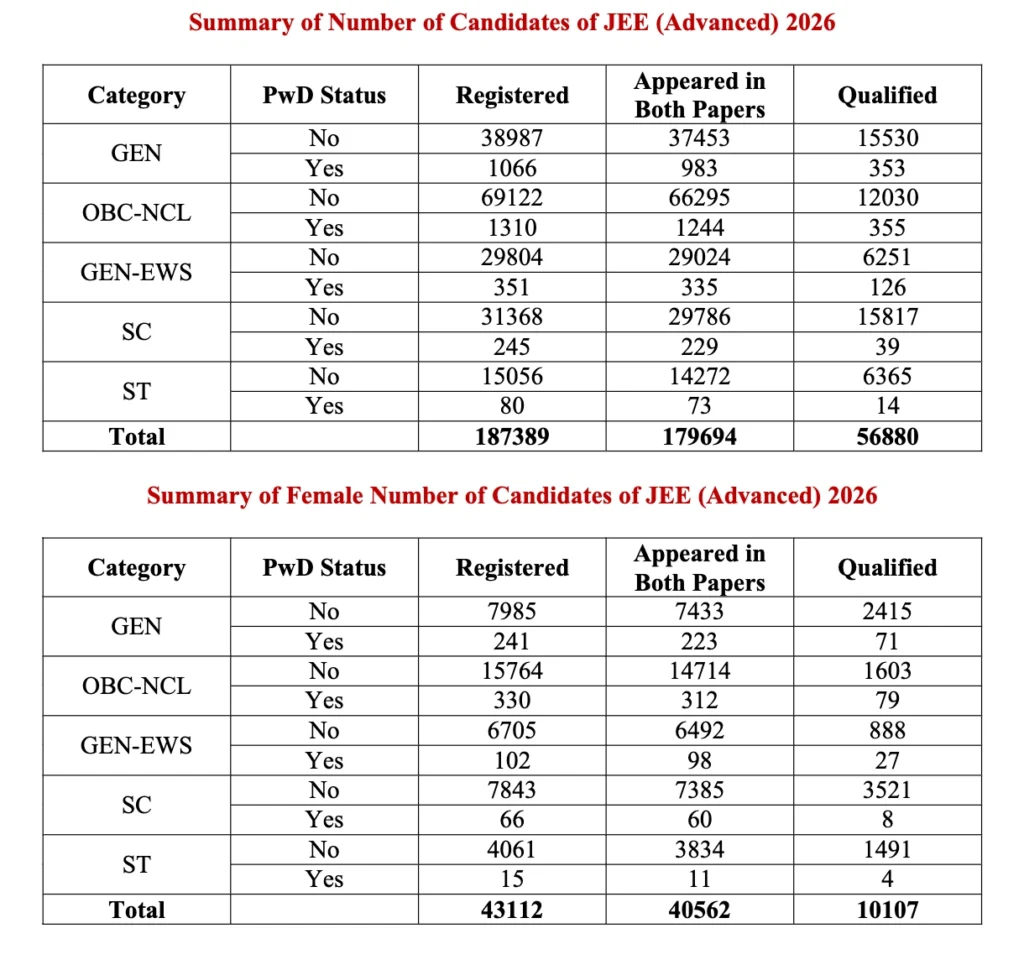
| Students Appeared | ~1.9 Lakh |
| Expected Qualifying Cutoff (General) | ~93–100 marks (projected; official brochure specifies 35% aggregate) |
| Overall Difficulty | Moderate to Difficult |
| Toughest Section | Mathematics & Physics (Paper 2) |
| Result Date | June 1, 2026 |
| Nit Details | Top Private College | IIIT Details | Government College Details | IIT Details | Gfti Details |
|---|---|---|---|---|---|
| Click | Click | Click | Click | Click | Click |
JEE Advanced 2026 Paper Pattern — What Changed?
Both papers had four sections each, but Paper 2 saw the most significant structural change in several years.
Paper 1 Pattern (Standard — No Major Changes)
Paper 1 followed the expected format:
| Section | Question Type | Marking Scheme |
|---|---|---|
| Section 1 | Single Correct | +3, −1 |
| Section 2 | More Than One Correct | +4, −1 (changed from −2) |
| Section 3 | Matching List | +3, −1 |
| Section 4 | Single-Digit Integer (No Negative) | +4, 0 |
The key change in Paper 1: Section 2 moved from −2 to −1 for incorrect multiple-choice answers. This is slightly more forgiving than last year and encourages slightly more attempts on uncertain questions.
Paper 2 Pattern — Biggest Change in Years
Paper 2 introduced a format that many students found unexpected:
| Section | Question Type | Marking Scheme |
|---|---|---|
| Section 1 | Single Correct | +3, −1 |
| Section 2 | More Than One Correct | +4, −1 |
| Section 3 | Numerical Based | +4, 0 |
| Section 4 | Paragraph-Based Numerical (NEW) | +2 per question, 0 |
The Paragraph-Based Numerical section was the new element. Two interconnected questions were based on a single paragraph — answer one correctly to unlock the full context for the second. This format rewards conceptual clarity over rote problem-solving. Students who rushed or skipped the paragraph found the +2 questions significantly harder.

Jee Advanced 2026 Subject-Wise Difficulty Analysis
Physics — Toughest Subject in Both Papers
Physics was the story of JEE Advanced 2026. Both Paper 1 and Paper 2 Physics were tough, lengthy, and deeply conceptual.
JEE Main has featured increasingly easy Physics for several consecutive sessions. JEE Advanced 2026 corrected this sharply. Questions demanded multi-concept thinking — not single-formula application. Students who prepared only at JEE Main-level Physics found both papers very difficult.
What made Physics hard:
- Questions required 3–4 conceptual links before reaching a solvable form
- Many problems were lengthy even after the approach was clear
- NCERT-level or JEE Main-level Physics was simply not enough
This is the subject that will pull the overall average score down significantly.
Maths — Lengthy, But Doable
Maths was surprisingly more accessible than Physics in 2026 — a reversal from many students’ expectations.
Characteristics of Maths 2026:
- Lengthy and calculation-heavy, but the approach was clear
- No “trap” questions designed to mislead — more straightforward than tricky
- Class 12 topics carried a higher weightage than Class 11
- Multi-chapter integration was present, as expected in JEE Advanced
Chemistry — The IIT Maker (Again)
As in most years, Chemistry was the subject that separated IIT qualifiers from those who fell short.
2026 Chemistry highlights:
- Organic Chemistry weightage increased significantly — the highest in several years
- Physical Chemistry numericals were standard difficulty
- Inorganic (NCERT-based) remained predictable
If your Organic was strong in 2026, Chemistry likely saved your total score even if Physics pulled it down.
| Nit Details | Top Private College | IIIT Details | Government College Details | IIT Details | Gfti Details |
|---|---|---|---|---|---|
| Click | Click | Click | Click | Click | Click |
Jee Advanced 2026 vs 2025 : Which one is Tougher
Here is a direct difficulty comparison across both years:
| Parameter | JEE Advanced 2025 | JEE Advanced 2026 |
|---|---|---|
| Paper 1 Overall | Doable / Moderate | Moderate |
| Paper 2 Overall | Moderate | Moderate to Difficult |
| Physics | Moderate | Tough (both papers) |
| Maths | Tough | Moderate-Tough |
| Chemistry | Moderate | Moderate (Organic heavier) |
| New Pattern Element | No | Yes (Paragraph Numericals in P2) |
| Expected Cut Off | ~75–80 marks | ~75–80 marks |
Bottom line: JEE Advanced 2026 is a 2025-level paper — not easier, not significantly harder. The 2016-era difficulty level is not expected to return. Students who attempted Paper 1 reasonably well and held their Maths and Chemistry in Paper 2 have a real chance at the cut off.
.webp "Jee Advanced 2026-2027 Analysis , ChapterWise Weightage, Official Answer key , Cutoff , Toughness, Marks vs Rank 4")
| Nit Details | Top Private College | IIIT Details | Government College Details | IIT Details | Gfti Details |
|---|---|---|---|---|---|
| Click | Click | Click | Click | Click | Click |
JEE Advanced 2026 Final Cutoff
The cutoff has been announced along with the results. Candidates can check cutoff in their JEE Adv 2026 scorecard. IIT Roorkee has published the cutoff in the official website and the same is provided here. Only those candidates who scored above the JEE Advanced cutoff 2026 has been declared qualified and got an All India Rank. The cutoff is different for all categories.
| Rank List | Minimum Marks in Each Subject | Minimum Aggregate Marks |
|---|---|---|
| Common Rank List (CRL) | 8 | 92 |
| OBC-NCL Rank List | 7 | 82 |
| GEN-EWS Rank List | 7 | 82 |
| SC Rank List | 4 | 46 |
| ST Rank List | 4 | 46 |
| Common-PwD Rank List (CRL-PwD) | 4 | 46 |
| OBC-NCL-PwD Rank List | 4 | 46 |
| GEN-EWS-PwD Rank List | 4 | 46 |
| SC-PwD Rank List | 4 | 46 |
| ST-PwD Rank List | 4 | 46 |
| Preparatory Course (PC) Rank List | 2 | 23 |
JEE Advanced 2025 Cutoff
The minimum qualifying marks for JEE Advanced 2025 are 35% for the General category, 31.5% for OBC-NCL/EWS, and 17.5% for SC/ST/PwD candidates. To qualify for JEE Advanced, you must also be among the top 2.5 lakh rank holders of JEE Main 2025. JEE Advanced 2025 exam has been rated difficult than JEE Advanced 2024. Candidates and experts expect the cutoff to drop. JEE Advanced 2025 Cutoff is expected to be around 75-80 marks.
| Rank List | Minimum marks in each subject (2025) | Minimum marks in each subject (2024) | Minimum aggregate marks out of 360 (2025) | Minimum aggregate marks out of 360 (2024) |
|---|---|---|---|---|
| Common rank list (CRL) | 7 | 10.0 | 74 | 109 |
| GEN-EWS rank list | 6 | 9.0 | 66 | 98 |
| OBC-NCL rank list | 6 | 9.0 | 66 | 98 |
| SC rank list | 3 | 5.0 | 37 | 54 |
| ST rank list | 3 | 5.0 | 37 | 54 |
| Common-PwD rank list (CRL-PwD) | 3 | 5.0 | 37 | 54 |
| GEN-EWS-PwD rank list | 3 | 5.0 | 37 | 54 |
| OBC-NCL-PwD rank list | 3 | 5.0 | 37 | 54 |
| SC-PwD rank list | 3 | 5.0 | 37 | 54 |
| ST-PwD rank list | 3 | 5.0 | 37 | 54 |
| Preparatory course rank lists | 1 | 2.0 | 18 | 27 |
Top Engineering College In Delhi NCR / Noida – Direct Admission – Click
JEE Advnaced 2026 Answer key & Solution PDF
JEE Advanced 2026 Chapter-Wise Weightage Analysis (Paper 1 & 2)
The JEE Advanced 2026 exam consisted of 102 questions carrying a total of 360 marks, with each subject (Physics, Chemistry, and Mathematics) contributing 34 questions and 120 marks. Based on the official paper analysis, some chapters dominated the paper while others received no questions. Students preparing for JEE Advanced 2027 should focus more on high-weightage topics such as Rotational Dynamics, Thermodynamics, Geometrical Optics, Chemical Bonding, p-Block Elements, Aromatic Compounds, Differential Calculus, Vectors, and Coordinate Geometry, as these chapters contributed significantly to the overall score.
JEE Advanced 2026 Physics Chapter-Wise Weightage
| S.No | Chapter | Questions | Marks | Weightage |
|---|---|---|---|---|
| 1 | Unit & Dimensions, Basic Mathematics & Vectors | 1 | 4 | 3.33% |
| 2 | Newton’s Laws of Motion and Friction | – | – | – |
| 3 | Kinematics | 1 | 4 | 3.33% |
| 4 | Circular Motion | – | – | – |
| 5 | Work, Power & Energy | – | – | – |
| 6 | Center of Mass, Momentum & Collision | – | – | – |
| 7 | Rotational Dynamics | 6 | 17 | 14.17% |
| 8 | Elasticity, Heat & Thermodynamics | 4 | 16 | 13.33% |
| 9 | Fluid Mechanics | – | – | – |
| 10 | Simple Harmonic Motion | 1 | 4 | 3.33% |
| 11 | Geometrical Optics | 4 | 14 | 11.67% |
| 12 | Electrostatics | 2 | 8 | 6.67% |
| 13 | Gravitation | – | – | – |
| 14 | Current Electricity | 2 | 7 | 5.83% |
| 15 | Capacitance | 2 | 4 | 3.33% |
| 16 | Magnetic Effects of Current & Magnetism | 2 | 8 | 6.67% |
| 17 | Electromagnetic Induction | 2 | 7 | 5.83% |
| 18 | Alternating Current | – | – | – |
| 19 | Wave on String | – | – | – |
| 20 | Sound Waves | 1 | 4 | 3.33% |
| 21 | Electromagnetic Waves & Wave Optics | 3 | 12 | 10.00% |
| 22 | Modern Physics | 2 | 7 | 5.83% |
| 23 | Errors in Measurements & Instruments | 1 | 4 | 3.33% |
| 24 | Semiconductor | – | – | – |
| Total | 34 | 120 | 100% |
Physics was heavily dominated by Rotational Dynamics (14.17%), followed by Elasticity, Heat & Thermodynamics (13.33%), Geometrical Optics (11.67%), and Wave Optics & Electromagnetic Waves (10%). Together, these four units contributed nearly 50% of the Physics paper, making them the most important chapters for future aspirants.
Top Engineering College In Delhi NCR / Noida – Direct Admission – Click
| Nit Details | Top Private College | IIIT Details | Government College Details | IIT Details | Gfti Details |
|---|---|---|---|---|---|
| Click | Click | Click | Click | Click | Click |
JEE Advanced 2026 Chemistry Chapter-Wise Weightage
Inorganic Chemistry
| Chapter | Questions | Marks | Weightage |
|---|---|---|---|
| Quantum Number & Electronic Configuration | 1 | 4 | 3.33% |
| Periodic Table | 1 | 4 | 3.33% |
| Chemical Bonding | 3 | 10 | 8.33% |
| Coordination Compounds | 2 | 8 | 6.67% |
| Salt Analysis | – | – | – |
| d-Block Elements | – | – | – |
| p-Block Elements | 3 | 12 | 10.00% |
| f-Block Elements | – | – | – |
Organic Chemistry
| Chapter | Questions | Marks | Weightage |
|---|---|---|---|
| IUPAC Nomenclature & Common Name | – | – | – |
| Electronic Displacement Effects (GOC) | – | – | – |
| Acidic Strength & Basic Strength | – | – | – |
| Isomerism | – | – | – |
| Purification & Characterisation of Organic Compounds | – | – | – |
| Alkyl Halides | – | – | – |
| Alcohol and Ethers | – | – | – |
| Hydrocarbon | 1 | 4 | 3.33% |
| Carbonyl Compounds | 3 | 11 | 9.17% |
| Oxidation of Organic Compounds | – | – | – |
| Reduction of Organic Compounds | – | – | – |
| Carboxylic Acids and Their Derivatives | 1 | 3 | 2.50% |
| Organic Compounds Containing Nitrogen | 2 | 8 | 6.67% |
| Aromatic Compounds | 4 | 12 | 10.00% |
| Biomolecules | 2 | 7 | 5.83% |
| Practical Organic Chemistry | – | – | – |
Physical Chemistry
| Chapter | Questions | Marks | Weightage |
|---|---|---|---|
| Mole Concept | – | – | – |
| Concentration Terms | – | – | – |
| Redox | – | – | – |
| Atomic Structure | 1 | 4 | 3.33% |
| Chemical Equilibrium | 1 | 3 | 2.50% |
| Liquid Solution | 3 | 8 | 6.67% |
| Chemical Kinetics | 1 | 4 | 3.33% |
| Thermodynamics 1 | 1 | 3 | 2.50% |
| Thermochemistry | – | – | – |
| Thermodynamics 2 | 1 | 4 | 3.33% |
| Ionic Equilibrium | – | – | – |
| Electrochemistry | 1 | 3 | 2.50% |
| Ideal Gas | 1 | 4 | 3.33% |
| Surface Chemistry | 1 | 4 | 3.33% |
Total | 34 | 120 | 100% |
Chemistry had a balanced distribution. The highest weightage chapters were p-Block Elements (10%), Aromatic Compounds (10%), Carbonyl Compounds (9.17%), Chemical Bonding (8.33%), and Coordination Compounds/Liquid Solutions (6.67%). Interestingly, several traditionally important chapters such as GOC, Isomerism, Mole Concept, Ionic Equilibrium, and d-Block Elements did not receive any questions.
Top Engineering College In Delhi NCR / Noida – Direct Admission – Click
JEE Advanced 2026 Mathematics Chapter-Wise Weightage
| S.No | Chapter | Questions | Marks | Weightage |
|---|---|---|---|---|
| 1 | Sets, Numbers & Intervals | – | – | – |
| 2 | Fundamentals of Algebra | – | – | – |
| 3 | Quadratic Equation | 2 | 8 | 6.67% |
| 4 | Logarithm | – | – | – |
| 5 | Sequence and Series | – | – | – |
| 6 | Trigonometric Ratios and Identities | 1 | 4 | 3.33% |
| 7 | Trigonometric Equations | 2 | 6 | 5.00% |
| 8 | Fundamental of Geometry | – | – | – |
| 9 | Solution of Triangles | – | – | – |
| 10 | Determinants | – | – | – |
| 11 | Straight Line | – | – | – |
| 12 | Circle | – | – | – |
| 13 | Parabola | 1 | 3 | 2.50% |
| 14 | Ellipse | 1 | 3 | 2.50% |
| 15 | Hyperbola | 2 | 8 | 6.67% |
| 16 | Permutations and Combinations | 1 | 4 | 3.33% |
| 17 | Binomial Theorem | – | – | – |
| 18 | Functions | 1 | 4 | 3.33% |
| 19 | Inverse Trigonometric Functions | 1 | 3 | 2.50% |
| 20 | Limits | – | – | – |
| 21 | Continuity | 1 | 4 | 3.33% |
| 22 | Differentiability | 2 | 8 | 6.67% |
| 23 | Methods of Differentiation | 1 | 4 | 3.33% |
| 24 | Tangent and Normal | 1 | 2 | 1.67% |
| 25 | Monotonicity | – | – | – |
| 26 | Maxima and Minima | 1 | 3 | 2.50% |
| 27 | Indefinite Integration | – | – | – |
| 28 | Definite Integration | 2 | 6 | 5.00% |
| 29 | Differential Equations | 2 | 7 | 5.83% |
| 30 | Area Under the Curve | 2 | 4 | 3.33% |
| 31 | Matrices | 1 | 4 | 3.33% |
| 32 | Vector | 2 | 7 | 5.83% |
| 33 | Three Dimensional Coordinate Geometry | 2 | 8 | 6.67% |
| 34 | Complex Numbers | 1 | 4 | 3.33% |
| 35 | Probability | 1 | 4 | 3.33% |
| 36 | Mathematical Reasoning | – | – | – |
| 37 | Statistics | 2 | 8 | 6.67% |
| 38 | Relations | 1 | 4 | 3.33% |
| 39 | Principle of Mathematical Induction | – | – | – |
| Total | 34 | 120 | 100% |
Mathematics showed a strong focus on Quadratic Equations, Hyperbola, Differentiability, 3D Geometry, and Statistics, each contributing 6.67% weightage. Differential Calculus as a whole remained highly important, while topics like Determinants, Straight Lines, Circles, Limits, Sequence & Series, and Binomial Theorem surprisingly received no direct questions.
JEE Advnaced 2026 Answer key & Solution PDF
Top Engineering College In Delhi NCR / Noida – Direct Admission – Click